A diesel forklift that will not start can bring a loading bay to a halt. A weak battery is one possible cause, especially after cold weather, long storage, or repeated short runs. But a jump start is not a cure for every no-start problem. A loose connection, failed starter, or fuel-system fault may need a different response.
How to jump-start a diesel forklift in emergency depends on the machine’s voltage, battery arrangement, and manufacturer’s instructions. Some forklifts use 12-volt systems; others use 24 volts or multiple batteries. Check the operator’s manual and the battery labels before connecting anything. Do not guess. A voltage mismatch can damage electrical components or create a serious hazard. Inspect the battery for cracks, leaks, swelling, or signs of freezing. If you see any of these, stop and call a qualified technician.
The work area matters. Park on level ground, lower the forks, set the brake, switch off the ignition, and keep flames or sparks away from the battery. Wear suitable eye protection and gloves. Follow the manufacturer’s cable sequence, using approved equipment rated for the forklift’s system. Keep cables clear of fans and moving parts. It sounds simple. It isn’t always. Even experienced operators can miss corrosion hidden beneath a clamp. After a successful start, let the engine run only as directed, then investigate why the battery lost charge. A jump start may get the forklift moving, but it should not replace diagnosis or routine battery maintenance.
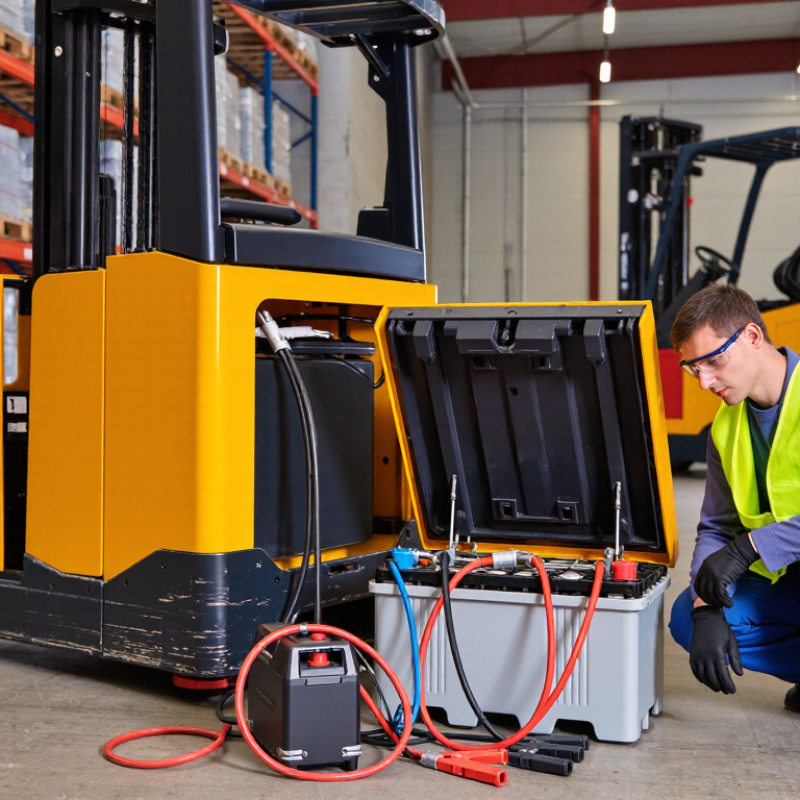
A diesel forklift may need a jump start when its battery cannot supply enough power to turn the engine. This often happens after the machine sits unused, especially in cold weather. Cold temperatures slow battery output, while thickened engine oil makes cranking harder. Diesel engines need strong, steady rotation to build compression and start. Some models also rely on glow plugs or an intake heater, which draw additional power. A few seconds of cranking may not be enough.
Small electrical loads can drain a battery over time. A work light left on overnight, a poorly closing switch, or a weak connection may be the cause. Corrosion around the terminals can also restrict current, even when the battery looks sound. That detail is easy to miss. A jump start may get the forklift running, but it does not explain why the battery became weak.
Repeated jump starts call for a closer check of the battery, cables, and charging system. Loose clamps, worn wiring, or a failing alternator can bring the same problem back. Before connecting cables, check the operator’s manual for the correct procedure and voltage. Never jump a cracked, leaking, or frozen battery. If the engine still turns slowly with a safe, proper connection, stop and arrange a qualified inspection; continuing to crank can strain the starter.
How to read this chart: A low resting voltage can indicate that a 12V lead-acid battery is discharged and may not have enough power to crank a diesel engine. Common causes include lights left on, cold conditions, an aging battery, loose or corroded connections, or a charging-system problem. These voltage values are approximate and should be checked with the battery rested. For a 24V forklift, follow the equipment manual and use the correct system voltage.
Before jump-starting a diesel forklift, read its operator manual. Battery layouts and approved connection points vary between machines. Park on firm, level ground, lower the forks, set the parking brake, and switch off the ignition. Keep the area ventilated; batteries can release explosive gas. No smoking or open flames. Pause here. Wear eye protection and suitable gloves, then check for cracks, leaks, swelling, or frozen battery cases. Do not jump-start a damaged battery.
Confirm that both systems have compatible voltage and polarity. A mismatch can damage electrical components or cause injury. Remove metal jewelry, and keep tools away from the battery terminals. Check cables for worn insulation or loose clamps. Follow the manual’s exact connection order, including its designated ground point. Never guess. Keep cables clear of fans, belts, and hot surfaces, and prevent the clamps from touching each other. I still find this easy to overlook when a machine is blocking work. If the battery condition is uncertain, the terminals are corroded, or the instructions are missing, stop and ask a qualified technician. A few minutes of checking is better than turning a simple start into a repair.
Before attempting a jump start, park on level ground, lower the forks, set the brake, and switch off the ignition. Check the forklift’s service manual for system voltage and approved connection points; diesel forklifts may use different electrical setups. Gather insulated, heavy-duty jumper cables, safety glasses, acid-resistant gloves, and a voltage meter. Remove jewelry. Keep sparks and cigarettes away. A damaged, leaking, swollen, or frozen battery is a stop sign, not a jump-start candidate. OSHA’s forklift safety guidance estimates about 85 fatal incidents and 34,900 serious injuries annually involving forklifts. That figure is not specific to jump-starting, but it shows why preparation matters.
Confirm both systems have matching voltage before connecting anything. Inspect cable insulation and battery terminals for corrosion or looseness. With both machines off, follow the manual’s cable sequence and designated grounding point; never guess at polarity. Keep the final connection away from the battery when the manual permits. Stand clear of moving parts, then start the assisting machine only if its instructions allow it. Crank in short attempts. Stop if cables heat up or the engine does not turn. OSHA standard 29 CFR 1910.178 also calls for designated battery-charging areas and suitable safeguards. The work can feel routine. It still deserves a second voltage check.
| Stage | Tool or Check | Safe Practice | Why It Matters |
|---|---|---|---|
| Why a jump start may be needed | Battery and starting-system check | A weak or discharged battery can prevent the starter from turning the diesel engine. Check for loose or corroded connections and other obvious faults before attempting a jump start. | A jump start may restore enough power to start the engine, but it does not fix a faulty battery, charging system, starter, or electrical connection. |
| 1. Check the operator’s manual | Forklift manual and battery labels | Follow the manufacturer’s jump-start procedure and identify the forklift’s required system voltage, approved connection points, and any model-specific restrictions. | Forklifts can use different electrical systems. The correct procedure and connection points vary by machine. |
| 2. Select a compatible power source | Compatible battery or approved jump-start power unit | Confirm that the power source has the same voltage as the forklift. Use equipment with adequate capacity and follow its instructions. Never connect a 12-volt source to a 24-volt system, or vice versa. | Incorrect voltage or an unsuitable power source can damage electrical components and create a safety hazard. |
| 3. Prepare the work area | Safety glasses, suitable gloves, and a ventilated area | Work in a well-ventilated location. Keep flames, cigarettes, sparks, and other ignition sources away from the battery. Remove metal jewelry and wear appropriate protective equipment. | Batteries can release flammable gas and contain corrosive electrolyte. Ventilation and protective equipment reduce the risk of injury. |
| 4. Secure the forklift | Parking brake, neutral setting, and fork position | Park on a firm, level surface; lower the forks fully; select neutral; apply the parking brake; switch off the ignition; and keep bystanders clear. | Securing the truck helps prevent unintended movement while connections are being made. |
| 5. Inspect the battery | Visual inspection; do not touch damaged battery areas | Do not jump start a battery that is cracked, leaking, swollen, visibly damaged, or suspected to be frozen. Stop and arrange qualified service if the battery condition is uncertain. | A damaged or frozen battery may rupture or create an explosion or chemical-exposure hazard. |
| 6. Inspect the cables | Insulated jump-start cables rated for the application | Check for damaged insulation, loose clamps, or exposed wire. Keep the clamps from touching each other or moving parts. Follow the cable and forklift instructions. | Damaged cables or accidental contact can cause short circuits, sparks, or burns. |
| 7. Connect the positive leads | Clearly identified positive (+) terminals or approved points | With both machines or power sources switched off as directed by their manuals, connect one red clamp to the disabled forklift’s positive (+) point, then connect the other red clamp to the assisting source’s positive (+) point. | Correct polarity is essential to reduce the risk of electrical damage and sparking. |
| 8. Connect the negative lead | Designated ground point specified by the forklift manual | Connect one black clamp to the assisting source’s negative (−) point. Connect the final black clamp to the forklift’s designated ground point, away from the battery, if the manual specifies one. Do not guess at a connection point. | Using the specified ground point helps keep any connection spark away from the battery. Some models require a different procedure. |
| 9. Start the diesel engine | Ignition and preheat controls | Follow the power-source instructions, then start the forklift according to its manual. If it has a preheat or glow-plug cycle, wait for the indicated cycle to finish before cranking. Do not crank continuously; observe the manual’s limits. | Proper preheating supports diesel starting, while excessive cranking can overheat the starter or cables. |
| 10. Disconnect the cables | Connected cables and manufacturer’s instructions | Once the engine is running, remove the clamps in the reverse of the connection order, keeping them clear of one another and moving parts. Follow the manuals for both machines or the power unit. | Removing the connections in the prescribed order helps reduce the risk of short circuits and sparks. |
| 11. After the start | Battery, charging-system, and warning-light check | Let the engine run only as directed by the manual. Check for warning lights or abnormal operation, and have the battery and charging system tested. If the forklift will not start, stop and contact qualified service personnel rather than repeating attempts indefinitely. | A jump start is temporary assistance; testing helps identify the cause of the discharge and prevent another no-start event. |
Park the forklift on firm, level ground, lower the forks fully, set the parking brake, and select neutral. Switch off the ignition and remove the key. Wear eye protection and gloves. Check the battery for cracks, leaks, swelling, or frozen cells; do not jump-start a damaged battery. Confirm the forklift’s required voltage in its manual, since some systems use 24 volts rather than 12. Use only a compatible support battery or booster. No guesswork.
Connect the red clamp to the forklift battery’s positive terminal, then connect the other red clamp to the support battery’s positive terminal. Attach the black clamp to the support battery’s negative terminal. Connect the final black clamp to the forklift’s designated chassis ground, away from the battery and moving parts. Keep clamps clear of each other. Follow the equipment and booster instructions for powering the source, then try starting the forklift. Crank for no more than about 10 seconds at a time, with a short pause between attempts. If it does not start, stop and investigate rather than repeating indefinitely.
Once the engine runs steadily, disconnect the clamps in reverse order, keeping them from touching metal or each other. Let the forklift idle briefly, then check for warning lights or unusual sounds. A weak battery may need testing or replacement; a jump-start is not a repair. If the connection points are unclear, pause and ask a qualified technician. Better a delay than a damaged electrical system.
Once the diesel forklift starts, keep it parked on level ground with the forks lowered, parking brake set, and transmission in neutral. Leave the engine at idle for a minute. Watch the oil-pressure gauge and temperature reading, and check that warning lights go out. Stop the engine if oil pressure stays low, a warning remains on, or the temperature rises quickly. Do not assume a smooth start means everything is fine. Listen for uneven knocking or a belt squeal, and look for fresh oil, fuel, or coolant beneath the machine. Check the exhaust, too. Heavy smoke that continues after startup deserves attention.
With the engine stable, confirm that the battery is charging if the forklift has a charging indicator. Disconnect jump leads only as directed in the operator’s manual; the correct sequence can vary by equipment. Keep clamps apart and away from moving parts. Let the engine run briefly, then check the gauges again. A short idle test is useful, but it cannot reveal every fault. If the forklift stalls, cranks weakly, or shows repeated warnings, shut it down and inspect the battery connections and cables before trying again. I have seen a rushed restart hide a loose connection. That is easy to miss. Do not operate the forklift until the cause is clear.
Park on level ground, lower the forks, set the brake, and switch off the ignition. Check the manual for system voltage and approved connection points. Wear safety glasses and acid-resistant gloves. Remove jewelry. Keep sparks away.
Do not jump-start a battery that is cracked, leaking, swollen, or frozen. Stop if the cables are damaged or terminals are loose. A second look matters.
Check the forklift manual and support battery before connecting cables. Some forklifts use 24 volts rather than 12. Never guess.
With both machines off, connect red to the forklift’s positive terminal, then to the support battery’s positive terminal. Connect black to the support battery’s negative terminal. Attach the final black clamp to the designated chassis ground, away from the battery and moving parts. Follow the manual if its sequence differs.
Try starting for no more than about 10 seconds at a time, with a short pause between attempts. Stop if cables heat up or the engine does not turn. Repeating attempts without checking can make a small problem worse.
Let the engine run steadily, then disconnect the clamps in reverse order unless the manual specifies otherwise. Keep clamps apart and away from metal. Easy to overlook.
Keep it parked with the forks lowered, brake set, and transmission in neutral. Watch the oil-pressure gauge, temperature, and warning lights. Listen for knocking or belt squeal, and check beneath the forklift for fresh fluid.
No. A weak battery may need testing or replacement. If the forklift stalls, cranks weakly, or shows repeated warnings, shut it down and investigate before operating. A brief idle check cannot reveal every fault. I would rather pause than assume the problem is solved.
A diesel forklift may need a jump-start when its battery is discharged after long storage, repeated short operating periods, or leaving electrical systems on. Before starting, park on level ground, lower the forks, select neutral, apply the parking brake, and switch off the ignition and accessories. Wear eye protection and gloves, keep sparks and flames away, and do not proceed if the battery is cracked, leaking, swollen, or frozen. Check the forklift’s manual and confirm that the booster battery has the correct voltage.
To understand How to jump-start a diesel forklift in emergency, prepare suitable, undamaged jumper cables and place the assisting power source safely nearby without allowing the machines to touch. Connect the positive cable to the positive terminals, then connect the negative cable to the designated ground point on the disabled forklift, following the manual’s instructions. Start the assisting source if appropriate, then try the forklift briefly; avoid prolonged cranking. Once the engine starts, disconnect the cables in reverse order and keep them clear of moving parts. Let the engine run, check for warning lights or unusual sounds, and have the battery and charging system inspected if the problem returns.

Neto Forklifts